
Earlier today, NASA had a press conference discussing the MESSENGER spacecraft's flyby of Mercury. It hasn't been very long since the data were acquired, and the excitement of the scientists on the panel was tangible. The results are still being interpreted, and some of them are very puzzling.
The most exciting result (in my opinion) was this image:
Nicknamed "The Spider", this crater is about 40 km in diameter and is surrounded by a bunch of radiating troughs. It also happens to be right smack in the middle of the huge 1500 km-in-diameter Caloris basin (which, by the way, is even bigger than scientists previously thought). The mysterious troughs are almost certainly tectonic features related to the ground in the center of the basin bulging and cracking, probably due to the intrusion of molten rock underground.
Everywhere else (that we know of) on Mercury, all we see is compressional tectonics, so this "spider" is really unusual. What caused all the bulging that formed the spider? Nobody know, but I'd bet money that it's related to the Caloris impact.
The recent flyby collected more than 1200 images, plus spectra, and topography data, and this is only the tip of the iceberg. There are two more flybys planned, and then the spacecraft will be in orbit around Mercury, possibly for years. Who knows what other surprises are in store?
Wednesday, January 30, 2008
Surprises from Mercury


Thursday, January 17, 2008
E.T. Phone ... Us?
There has been some news lately about a signal detected at Arecibo that was reported to be potentially from extraterrestrial intelligence. Unfortunately, it appears that E.T. is not calling us, it was just that the reporter who wrote the story was lacking in any form of intelligence, terrestrial or otherwise.
Phil Plait at Bad Astronomy has the details.
Wednesday, January 16, 2008
MESSENGER's new views of Mercury!
The Messenger spacecraft just did a flyby of Mercury and has returned the first of what are sure to be many spectacular images.
In the upper right hand side of the planet, there is a large, roughly circular, lighter toned area. This is the Caloris basin, so named because it is the point on Mercury that faces the sun when the planet is at perihelion. Before this image, the best pictures of Mercury's surface were those taken in 1974 by Mariner 10. The Caloris basin was right on the terminator (the transition between day and night) at that time, so everything to the west of the basin in this new image has never been seen before. Ever. By anyone.
Over the next few days, we should be seeing some more new images as they are sent back to Earth. Messenger will fly by Mercury again on October 6, 2008 and September 29, 2009 before finally settling into orbit around the planet in March of 2011. Once in orbit we will really begin in earnest to learn about this neglected planet.
For more detailed information, check out the Planetary Society Blog and Bad Astronomy.

Monday, January 14, 2008
Asteroids Miss Mars and Earth
Well, it looks like Mars is not going to be hit by the asteroid that was causing a buzz a few weeks ago. Here's a cool animation showing the decreasing uncertainty in the asteroid's path as more data was gathered.
In other news, on January 13, a 27 meter asteroid passed by earth at about the distance of the moon. Check it Out.
Saturday, December 29, 2007
96% Chance of Nothing Happening on Mars
Or, put another way, the chances of impact on Mars are 1 in 25.
Bad Astronomy and the Planetary Society Blog have more information.
Saturday, December 22, 2007
Asteroid May Hit Mars!
NASA just put out a press release announcing the possibility that an asteroid 164 feet (50 meters) across may slam into Mars next month. Based on the uncertainties in its trajectory, scientists are giving it a 1 in 75 chance of impact. The asteroid is traveling at about 30,000 miles per hour. If it hits Mars, the impact would release as much energy as three million tons of dynamite, and would leave a crater more than a half-mile wide.
It will be really interesting if this thing actually does impact Mars. There are enough spacecraft on and around the red planet that we would get some really interesting information about the effects of medium-sized impacts (not to mention some awesome pictures of the aftermath). A lot of the press releases have been comparing this potential impact with the Tunguska event: a large explosion over Siberia in 1908. This is misleading though, because the Tunguska event was likely caused by a mid-air explosion of an asteroid, rather than an impact into the surface. Since the explosion happened in mid-air, nobody is quite sure how large the impactor was. In fact, recent results show that it may have been only 20 meters across!
In any case, I find it pretty amazing that we are good enough at tracking rocks in space to be able to tell whether or not they will hit, not just the earth, but any other planet as well. This potential impact on Mars should also serve as a reminder that things like this can and do happen to earth too.
The Arecibo radar/radio telescope has been crucial in identifying and studying near-earth asteroids, but recently its funding for planetary radar was cut to save a few million dollars. Planetary radar is the best way to track potentially dangerous objects, and Arecibo is 20 times more sensitive than any other radar telescope. Arecibo's planetary radar could literally save the world, and it is being shut down to save money. To learn more, check out this statement from the Planetary Society.


Tuesday, December 18, 2007
Astronomy Pictures of the Year
The Astronomy Picture of the Day website just put up their choices for Astronomy Picture of the Year 2007. Believe it or not, my personal favorite is not a photo of Mars. It's of the spectacular Comet McNaught from last January:

Sunday, December 16, 2007
Hot Jupiters

(Image Credit: NASA)
Picture a world where the year is 5 earth-days long, and the sun never rises or sets, but remains fixed directly overhead. The cloud tops on the sunlit side of the planet are thousands of degrees, and are made of vaporized minerals and metals. Iron smog and wisps of quartz are shunted from the scorching daylit side to the perpetually dark night side, which glows a dull red, pouring its excess heat into space. The upper hydrogen atmosphere is continually ripped from the planet and streams out into space like the tail of a comet.
Although it sounds like it belongs in the realm of science fiction, this description may actually be quite accurate for many of the planets that astronomers have found around other stars. The most successful method for detecting planets, called the "radial velocity" method, relies on detecting the small motions of stars as their planets orbit and tug them back and forth. Just as the siren on an ambulance is higher pitched when it is approaching than when it is receding, the light from a star looks slightly bluer when the star is moving toward us and slightly redder when it is moving away. Since the size of the shift depends upon the mass of the planet and how rapidly it orbits, many of the exoplanets discovered are larger than Jupiter, and orbit their star in a matter of days.
The first "hot jupiters" were a shock to the scientific community because it is thought that gas giants have to form very rapidly, before their star becomes hot enough to blow all of the primordial gas out of the system. To form so rapidly, most formation theories require the giant planets to form far enough out in the solar system for ices to be present. Too close to the sun and the only things that can clump together to form the seed for a giant planet are rocks. Farther out, beyond the so-called "snow line", ice can also clump together with the rocks, allowing the cores of giant planets to form rapidly and accumulate gas before it gets blown away.
Because ice appears to be required to form giant planets, how can they possibly form so close to their stars? The answer is: they don't! The latest research suggests that in the early days of a solar system, the planets move around quite a bit. Often, big planets toss small things like comets, asteroids, and protoplanets out of the solar system. As they fly off into interstellar space, these small pieces of debris take energy and angular momentum from the giant planet with them. The result is that giant planets tend to drift inward as they fling things outward. At the same time, if there is still gas in the system, the planet will also interact with that gas, creating waves. These waves also steal the planet's angular momentum and send it spiraling inward. In this way, a giant planet could conceivably form in the icy outer reaches of the solar system and then bully its way inward, scattering debris and making waves as it does so.
The story of hot Jupiters is a great example of science in action: giant planets were discovered a lot closer to their stars than they had any right to be, based on our understanding of planet formation. Far from weakening the theory however, the discovery of "hot jupiters" let scientists to figure out that planet migration is a very important process in the formation of a solar system. The theory emerged stronger than ever, able to explain a wider variety of potential solar systems.
So, next time you step outside, take a look at the rocks on the ground and think about a world so hot that those rocks vaporize and form clouds. And then, while you're marveling at that idea, remember that worlds like that really do exist!
"The Universe is not only queerer than we suppose, but queerer than we can suppose." - J.B.S. Haldane
Image credit: European Space Agency, Alfred Vidal-Madjar (Institut d'Astrophysique de Paris, CNRS, France) and NASA.

Saturday, December 15, 2007
Science Debate!
There has been a recent movement among science blogs and activists to organize a science debate for the presidential candidates. This is, in my opinion, an excellent idea. It would not have to be like a science test, nobody expects candidates to be scientists, but we should expect them to be in touch with reality, and to understand how science affects policy. As our society becomes more reliant upon technology and faces challenges in medicine, energy, defense, and the environment, a scientifically literate president is crucial. I encourage everyone to check out the official Science Debate 2008 website, and read some of the excellent blog posts, and editorials on the topic.
Wednesday, December 12, 2007
Spirit Rover has Camoflage!?
In this recent "deck pan" of the Spirit rover, the solar panels are so covered in dust that they blend in almost perfectly with the surrounding dusty martian surface.
All that dust means that the rover has less power to work with every day. With martian winter approaching in a few weeks, the Rover team has been working nonstop trying to drive Spirit to a location where the solar panels will be tilted toward the sun. The rover will camp there, trying to conserve energy until spring comes and there is enough power to drive once again.
Here's hoping for a gust of wind to clean off the panels and make life a little easier for Spirit...

Wednesday, December 5, 2007
A Candle in the Dark
Once finals are over, I will make a few honest-to-goodness posts, where I actually write a lot about something interesting. For now, enjoy this cartoon I found, and the Sagan quote that expresses the same idea but with a somewhat different tone...
"I worry that, especially as the Millennium edges nearer, pseudo-science and superstition will seem year by year more tempting, the siren song of unreason more sonorous and attractive. Where have we heard it before? Whenever our ethnic or national prejudices are aroused, in times of scarcity, during challenges to national self-esteem or nerve, when we agonize about our diminished cosmic place and purpose, or when fanaticism is bubbling up around us-then, habits of thought familiar from ages past reach for the controls.
The candle flame gutters. Its little pool of light trembles. Darkness gathers. The demons begin to stir."
- Carl Sagan, The Demon-Haunted World: Science As a Candle in the Dark

Thursday, November 29, 2007
The largest star...
After years of studying astronomy, I am not often shocked by those "scale of the universe" demonstrations that you often see, but I just came across a really impressive one (click it to see the original page with slightly larger images):

Wednesday, November 28, 2007
Green Hybrid Biodiesel Hummers?! Oh My.
So, I recently came across this article about a guy who is making cars ridiculously fuel efficient while increasing horsepower. Check it out:
Goodwin leads me over to a red 2005 H3 Hummer that's up on jacks, its mechanicals removed. He aims to use the turbine to turn the Hummer into a tricked-out electric hybrid. Like most hybrids, it'll have two engines, including an electric motor. But in this case, the second will be the turbine, Goodwin's secret ingredient. Whenever the truck's juice runs low, the turbine will roar into action for a few seconds, powering a generator with such gusto that it'll recharge a set of "supercapacitor" batteries in seconds. This means the H3's electric motor will be able to perform awesome feats of acceleration and power over and over again, like a Prius on steroids. What's more, the turbine will burn biodiesel, a renewable fuel with much lower emissions than normal diesel; a hydrogen-injection system will then cut those low emissions in half. And when it's time to fill the tank, he'll be able to just pull up to the back of a diner and dump in its excess french-fry grease--as he does with his many other Hummers. Oh, yeah, he adds, the horsepower will double--from 300 to 600.
"Conservatively," Goodwin muses, scratching his chin, "it'll get 60 miles to the gallon. With 2,000 foot-pounds of torque. You'll be able to smoke the tires. And it's going to be superefficient."
He laughs. "Think about it: a 5,000-pound vehicle that gets 60 miles to the gallon and does zero to 60 in five seconds!"
Monday, November 26, 2007
Thanksgiving with the Kranzes
I have been a total delinquent so far when it comes to making actual blog posts. I have lots of ideas for things to post here, but I haven't had time to sit down and write them up. Maybe later this week? Maybe.
In the mean time, please enjoy this thanksgiving parody of Apollo 13. Apparently it was put together by some employees at Johnson Space Center, and rumor has it that Gene Kranz himself now shows it to his family every thanksgiving. Of course, I can't verify that, but I can guarantee that if you've seen Apollo 13, you'll enjoy this:
Tuesday, November 20, 2007
Communicating Science
Via the blog framing science, here's an excerpt from an interview on point of inquiry of Neil deGrasse Tyson discussing his strategy for communicating science in a sound bite:
GROTHE Do you think that mass media, going that route, do you think it undercuts your science education agenda because you have to speak in sound bites, you have to reduce it down to the simplest terms for the widest appeal?
TYSON: That is an excellent question. I think what I have done--and invested a fair amount of social, cultural, and intellectual effort in-- is to recognize and understand the various parameters around the media I am using.
For example, if I am invited onto the Colbert Report or the Daily Show with Jon Stewart, I am going to study previous episodes of what the dynamics are between the host and the guest and I am going to see what kind of opportunity does the guest have to speak, how many words are likely to come out of my mouth before I am playfully interpreted ...because they are comedy shows of course.
So I will then package the message I want to deliver into the context of that program. That takes effort, I think most people don't do that and I think it makes for awkward moments.
I do that willingly because I am visiting them in their medium. If they are going to come to my college class, and they are going to listen to my one hour lecture, I am not going to sound bite it for them at that time. They are visiting me in my habitat.
The moment I go into their habitat, I owe the viewer, a delivery of content that fits that habitat. So my challenge then is how do I not compromise on either the principles or the content of science yet deliver it in a form commensurate with the comedic short form sound bite or the evening news sound bite which is a little different...
For any of us who are scientists there is always the temptation to dumb down our field to share it with someone who is uninitiated in the language, in the subject matter, the jargon...there is a strong urge to do that, but it is possible to resist that I have found.
But to resist it you have to know what is going on in the mind of the person. What are the tangled pathways that may interfere with what you are about to say? When you understand that, then you can shape your content in a way that does not dumb it down but that best intersects their capacity to receive it.
Thursday, November 15, 2007
Big Comet!
Comet Holmes, the comet that suddenly brightened by a factor of several million a few weeks ago, has now expanded to a diameter of 1.4 million kilometers. That's bigger than the sun! Of course, its nucleus is still tiny, it's the coma, the cloud of gas around the nucleus that is so huge. Check here for more information.

Wednesday, November 14, 2007
HDTV... from the Moon!
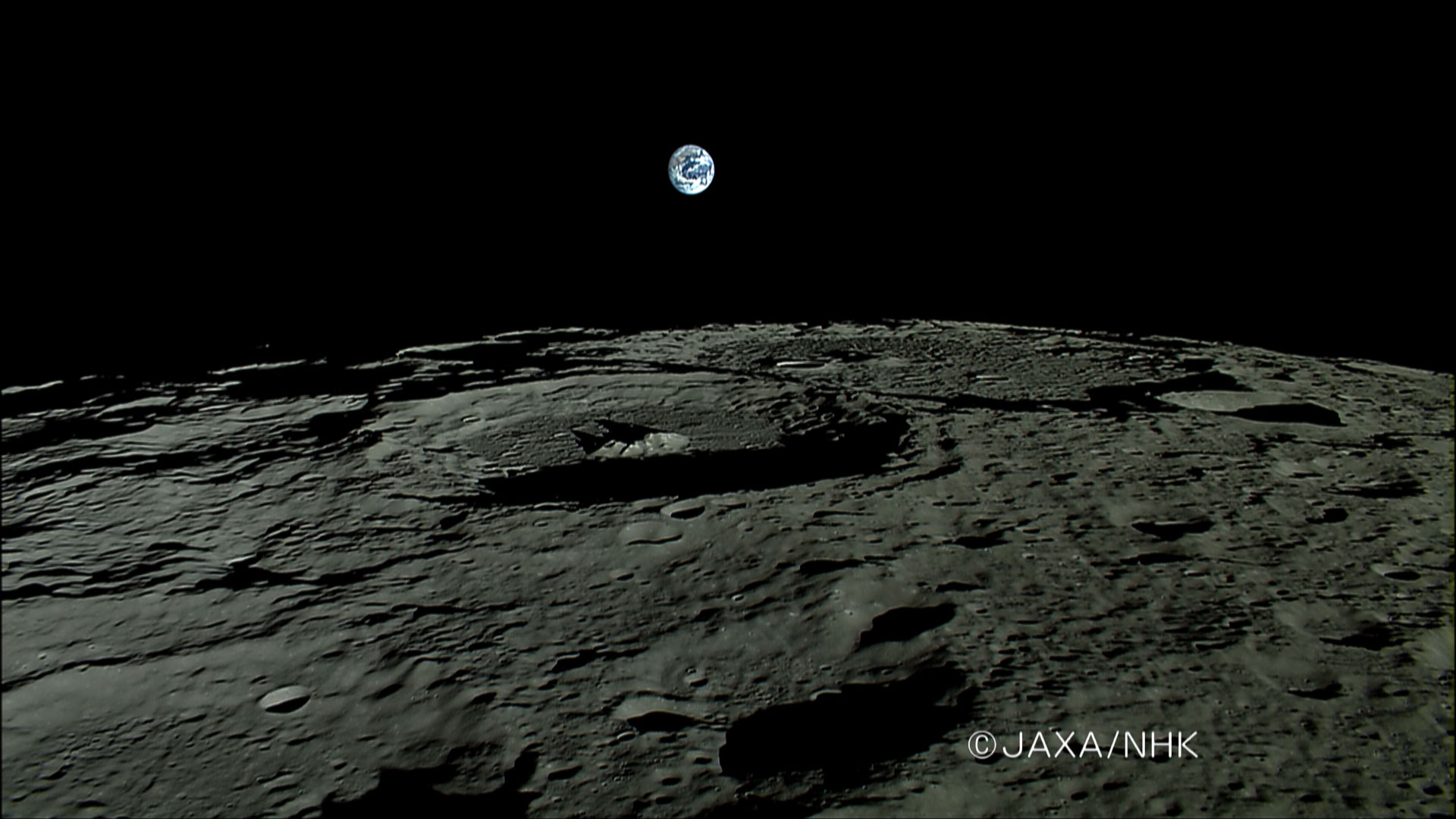
I'm a sucker for pictures of the earth from space, as you may have guessed from this blog's title image. So I had to point out these awesome pictures of earth setting over the moon taken by Japan's Kaguya spacecraft. Also, last week JAXA released a sample of the first HDTV transmission from the moon, taken by the same spacecraft.
I got the heads-up on both of these press releases from the Bad Astronomy blog, one of the best science blogs out there.
Saturday, November 10, 2007
Genetic Engineering
Note: The following is a rant on a topic outside my area of expertise. Please correct me if I have my facts wrong!
I was riding the bus back from campus yesterday when I overheard two Cornell students in the midst of a heated discussion. Their disagreement came about because, although they were both in favor of supporting sustainability and the environment, one of them couldn't believe that the other was in favor of genetic engineering. When the other student pressed the first about what was so wrong with genetic engineering, the first student responded: "It's genetic engineering, as in, engineering genes! We're creating new genes that have never been seen in nature before!"
I have some problems with this argument. First, the visceral reaction that engineering genes is somehow forbidden territory is nonsense. We have been engineering genes for centuries. Every domesticated animal and plant has been mutated by selective breeding so that, in some cases, they scarcely resemble their original species. Take a look at a Shar Pei or a Sphynx (hairless cat) and tell me those are not the result of genetic experiments. Corn is another example: it has been bred from a wild American grass to the towering stalk with bulging ears that we are used to.
Genetic engineering is only different from selective breeding in that we have much more precise control, and that new genes can be introduced. I fail to see how introducing a gene to tomatoes that makes them resist frost, or to soybeans that prevents insects from eating them, is a bad thing. It seems like a pretty fine line to walk if making crops yield more through breeding is good, but through genetic engineering is bad.
The student's comment that we are introducing never-before-seen genes is also, as far as I know, wrong. I don't think we're at the point where a geneticists have little keyboards with the letters AGCT and they can just type out a code for a gene that does what they want. Genetic engineering is limited to taking genes from one organism and splicing them into the DNA of another organism. We're not making new genes, we're making new combinations. The same can be said for sexual reproduction.
There are some valid concerns of course, and I don't claim to be an expert on this topic. One concern is that the genetically modified species could interbreed with wild species and affect the ecosystem. This is a real risk; similar to introducing non-indigenous species, a genetically modified species could out-compete its rivals and mess things up. But of course, since I feel like playing devil's advocate: isn't that how evolution works? Whether the advantage comes from
a natural or lab-induced mutation, the result is the same.
There's also the question of ethics: "Is it 'right' to modify species to fit our needs?" Again I point to the precedent of thousands of years of breeding. If it is morally ok for us to make breeds of dogs that can barely function, I think it's ok for us to make species that have a survival advantage.
As I said, I am not an expert on this topic. If you disagree with me, that's fine. If I have my facts wrong, I encourage you to bring it to my attention! I'll edit this post or make a follow-up if I'm wrong.
Good MSL News!
Alan Stern, the Associate Administrator of NASA's Science Mission Directorate, and Jim Green, the director of NASA's Planetary Science Division, recently made a very welcome announcement to the Mars community. After a lot of work from everyone involved, the cost issues with both the descent imager MARDI and ChemCam have been resolved and the two instruments will be flying on MSL!
MARDI is a high-definition color video camera that will send back footage of MSL's landing. We will finally be able to watch a video of the landing instead of relying on telemetry to tell us what's going on and computer simulations to show what happened!
ChemCam is an instrument that sounds like it could be straight out of Star Wars. It uses a laser to vaporize a small amount of a target rock from up to 30 feet away, then analyzes the spectrum of light emitted by the superheated plasma to determine what the rock is made of. By repeatedly zapping the same place on a rock, it can blast away dust covering the surface, and even drill through thin coatings of alteration on rocks to find out how their composition changes below the surface. Finaly, since it has to have a powerful telescope to collect the plasma light, it is also able to take extremely detailed images from a distance.
It is great to hear that these instruments are both back on the mission. I'll keep you posted with other MSL developments as I hear about them.
Wednesday, October 31, 2007
Summary of MSL Landing Sites
Emily Lakdawalla has posted a really excellent summary of the landing site workshop in a long, but more coherent, post than the three that I made. Check it out.


