
I've moved! I am now blogging at:
http://martianchronicles.wordpress.com/
Friday, March 7, 2008


Thursday, February 21, 2008
Spy Satellite Explosion Video
Check it out, the pentagon has released a video of their destruction of a dead spy satellite:
Monday, February 18, 2008
Odds Look Good for Rocky Planets

In a NASA press release yesterday, two teams of astronomers announced complimentary research that suggests that earth-like planets around sun-like stars may be common.
The first team used the Spitzer space telescope to survey a bunch of sun-like stars of varying ages. They were looking for evidence of dust kicked up by the collision of planetesimals. Planets form in a disk of debris around their star. As smaller rocks collide, they stick together to form larger rocks. With more gravity, the larger rocks attract more mass, and you get runaway growth. It's a messy process though, and many of the collisions create small particles even as they add most of their mass to the growing planetesimals. It is these small dust particles that the Spitzer team searched for. Warmer dust is associated with formation of planets close to their star, like the earth. The astronomer found that 10 to 20 percent of young sun-like stars have warm dust, but stars older than 300 million years don't. This suggests that planet formation is common and that it runs to completion within the first couple hundred million years.
The second study is based on theoretical models of how planets form. They confirmed that dust is a by-product of rocky planet formation and offer up two ways of interpreting the dust observed by the Spitzer team. First, it is possible that the dust lingers for a while, so that even if planet formation happens in only ten million years, the dust sticks around and you see it even for older stars that have finished forming planets. If this is true, then about 20% of sun-like stars have planets. Another possibility is that big disks form planets fast and their dust gets eaten up, while less massive disks take longer, so their dust persists. Interpreted this way, the Spitzer dust observations could mean that up to 60% of sun-like stars form planets.
In reality, it is probably some combination of the two effects, which means that the likelihood of forming planets is somewhere between 20 and 60 percent. Pretty good odds, if you ask me.
For the original press release, check here.
Sunday, February 17, 2008
Quotes: Ray Bradbury
I collect quotes. To see the full collection, check my website. Yesterday, while reading some short stories by Ray Bradbury, I came across two passages that I thought I would share. The first is often partially quoted and it was nice to finally see it in its full context. It, like much of Bradbury's best writing, is almost like poetry:
"What are we? Why, we are the miracle of force and matter making itself over into imagination and will. Incredible. The Life Force experimenting with forms. You for one. Me for another. The Universe has shouted itself alive. We are one of the shouts. Creation turns in its abyss. We have bothered it, dreaming ourselves to shapes. The void is filled with slumbers; ten billion on a billion on a billion bombardments of light and material that know not themselves, that sleep moving and move but finally to make an eye and waken on themselves. Among so much that is flight and ignorance, we are the blind force that gropes like Lazarus from a billion-light-year tomb. We summon ourselves. We say, O Lazarus Life Force, truly come ye forth. So the Universe, a motion of deaths, fumbles to reach across Time to feel its own flesh and know it to be ours. We touch both ways and find each other miraculous because we are One."
-Ray Bradbury, in his short story "G.B.S. - Mark V"
The second quote needs a little explanation. The story is about a race of robots in the distant future, when all life has been exterminated. The second speaker, Ultar, is a robot scientist who has just created a human from the "protoplasm" and is reflecting on the differences between humans and robots:
Kront said, "Why did you do it? Why have you made this thing of flesh and imperfection?"
"Why?" Ultar turned to the box. "Look at him, this creature, this man, so small, so vulnerable. His life is worth something because of his very vulnerability. Out of his fear and terror and uncertainty he once created great art, great music and great literature. Do we? We do not.
"How can a civilization create when it lives forever and nothing is of value? Things only take value from their evanescence, things are only appreciated because they vanish. How beautiful a summer day is that is only one of a kind; you have all seen such days --- one of the few things of beauty that we know, the weather, which changes. We do not change, therefore there is no beauty and no art.
"See him here, in his box, dreaming, about to wake. Little frightened man, on the edge of death, but writing fine books to live long after. I've seen those books in forbidden libraries, full of love and tenderness and terror. And what was his music but a proclamation against the uncertainty of living and the sureness of death and dissolution? What perfect things came from such imperfect creatures. They were sublimely delicate and sublimely wrong, and they waged wars and did many bad things, which we, in our perfectness cannot understand.
"we cannot understand death, really, for it is so rare among us, and has no value. But this man knows death and beauty and for that reason I created him so that some of the beauty and uncertainty would return to the world. Only then could life have any meaning to me, little as I can appreciate it with my limited faculties.
"He had the pleasure of pain, yes, even pain a pleasure, in its own way, for it is feeling and being alive; he lived, and he ate, which we do not do, and knew the goodness of love and raising others like himself and he knew a thing called sleep, and in those sleepings he dreamed, a thing we never do, and here he is now, dreaming fine things we could never know or hope to understand. And you are here, afraid of him and afraid of beauty and meaning and value."
-Ray Bradbury, in his short story "A Blade of Grass"
Sagan Stamps
The Ithaca Sciencenter recently unveiled three potential designs for stamps commemorating Carl Sagan and his work as a science popularizer, scientist, and activist. See the Cornell Chronicle for the full story.


Friday, February 15, 2008
Colbert's Fallback Position: Astrophysicist
Neil Tyson shows Colbert how to become an astrophysicist.
Spy Eye in the Sky to Die

If you haven't heard yet, here's the deal: a week or so ago, it was announced that the spy satellite USA 193 is disabled and will come streaking down to earth in a fireball some time in March. Needless to say, that could be cool to see, but it could also be dangerous.
Now the twist: MSNBC reports that the pentagon is going to blast the satellite with a missile before it re-enters to "minimize the risk to humans from its toxic fuel". Really? The toxic fuel is the problem? It's not that they don't want the remains of advanced technology falling into the wrong hands? It's not that they want to show that China is not the only nation that can blow a satellite out of the sky?
It will be interesting to see the repercussions this has on US space policy. Weapons and space together in any form are generally seen as a bad thing, unless, apparently, there's a spy satellite full of toxic fuel.
Thursday, February 14, 2008
Space Valentines
Since it is Valentine's Day, I thought it would be fitting to post some spacey valentine images. Of course, the Bad Astronomer beat me to the punch, but I have one more to add.
A Rose by any other Name...
This one is an image of a reflection nebula taken by the Spitzer infrared space telescope. It was also, incidentally, taken by my first research advisor, Tom Megeath.
Thursday, February 7, 2008
Space Shuttle Launch!

The Space Shuttle Atlantis is set for launch in 5 hours and 50 minutes, assuming the weather holds. Check out the NASA site for updates.
UPDATE: Atlantis launched successfully and is on its way to the International Space Station!
Wednesday, January 30, 2008
Surprises from Mercury
Earlier today, NASA had a press conference discussing the MESSENGER spacecraft's flyby of Mercury. It hasn't been very long since the data were acquired, and the excitement of the scientists on the panel was tangible. The results are still being interpreted, and some of them are very puzzling.
The most exciting result (in my opinion) was this image:
Nicknamed "The Spider", this crater is about 40 km in diameter and is surrounded by a bunch of radiating troughs. It also happens to be right smack in the middle of the huge 1500 km-in-diameter Caloris basin (which, by the way, is even bigger than scientists previously thought). The mysterious troughs are almost certainly tectonic features related to the ground in the center of the basin bulging and cracking, probably due to the intrusion of molten rock underground.
Everywhere else (that we know of) on Mercury, all we see is compressional tectonics, so this "spider" is really unusual. What caused all the bulging that formed the spider? Nobody know, but I'd bet money that it's related to the Caloris impact.
The recent flyby collected more than 1200 images, plus spectra, and topography data, and this is only the tip of the iceberg. There are two more flybys planned, and then the spacecraft will be in orbit around Mercury, possibly for years. Who knows what other surprises are in store?
Thursday, January 17, 2008
E.T. Phone ... Us?
There has been some news lately about a signal detected at Arecibo that was reported to be potentially from extraterrestrial intelligence. Unfortunately, it appears that E.T. is not calling us, it was just that the reporter who wrote the story was lacking in any form of intelligence, terrestrial or otherwise.
Phil Plait at Bad Astronomy has the details.
Wednesday, January 16, 2008
MESSENGER's new views of Mercury!
The Messenger spacecraft just did a flyby of Mercury and has returned the first of what are sure to be many spectacular images. 
In the upper right hand side of the planet, there is a large, roughly circular, lighter toned area. This is the Caloris basin, so named because it is the point on Mercury that faces the sun when the planet is at perihelion. Before this image, the best pictures of Mercury's surface were those taken in 1974 by Mariner 10. The Caloris basin was right on the terminator (the transition between day and night) at that time, so everything to the west of the basin in this new image has never been seen before. Ever. By anyone.
Over the next few days, we should be seeing some more new images as they are sent back to Earth. Messenger will fly by Mercury again on October 6, 2008 and September 29, 2009 before finally settling into orbit around the planet in March of 2011. Once in orbit we will really begin in earnest to learn about this neglected planet.
For more detailed information, check out the Planetary Society Blog and Bad Astronomy.
Monday, January 14, 2008
Asteroids Miss Mars and Earth
Well, it looks like Mars is not going to be hit by the asteroid that was causing a buzz a few weeks ago. Here's a cool animation showing the decreasing uncertainty in the asteroid's path as more data was gathered.
In other news, on January 13, a 27 meter asteroid passed by earth at about the distance of the moon. Check it Out.
Saturday, December 29, 2007
96% Chance of Nothing Happening on Mars
Or, put another way, the chances of impact on Mars are 1 in 25.
Bad Astronomy and the Planetary Society Blog have more information.
Saturday, December 22, 2007
Asteroid May Hit Mars!
NASA just put out a press release announcing the possibility that an asteroid 164 feet (50 meters) across may slam into Mars next month. Based on the uncertainties in its trajectory, scientists are giving it a 1 in 75 chance of impact. The asteroid is traveling at about 30,000 miles per hour. If it hits Mars, the impact would release as much energy as three million tons of dynamite, and would leave a crater more than a half-mile wide. 
It will be really interesting if this thing actually does impact Mars. There are enough spacecraft on and around the red planet that we would get some really interesting information about the effects of medium-sized impacts (not to mention some awesome pictures of the aftermath). A lot of the press releases have been comparing this potential impact with the Tunguska event: a large explosion over Siberia in 1908. This is misleading though, because the Tunguska event was likely caused by a mid-air explosion of an asteroid, rather than an impact into the surface. Since the explosion happened in mid-air, nobody is quite sure how large the impactor was. In fact, recent results show that it may have been only 20 meters across!
In any case, I find it pretty amazing that we are good enough at tracking rocks in space to be able to tell whether or not they will hit, not just the earth, but any other planet as well. This potential impact on Mars should also serve as a reminder that things like this can and do happen to earth too.
The Arecibo radar/radio telescope has been crucial in identifying and studying near-earth asteroids, but recently its funding for planetary radar was cut to save a few million dollars. Planetary radar is the best way to track potentially dangerous objects, and Arecibo is 20 times more sensitive than any other radar telescope. Arecibo's planetary radar could literally save the world, and it is being shut down to save money. To learn more, check out this statement from the Planetary Society. 
Tuesday, December 18, 2007
Astronomy Pictures of the Year
The Astronomy Picture of the Day website just put up their choices for Astronomy Picture of the Year 2007. Believe it or not, my personal favorite is not a photo of Mars. It's of the spectacular Comet McNaught from last January: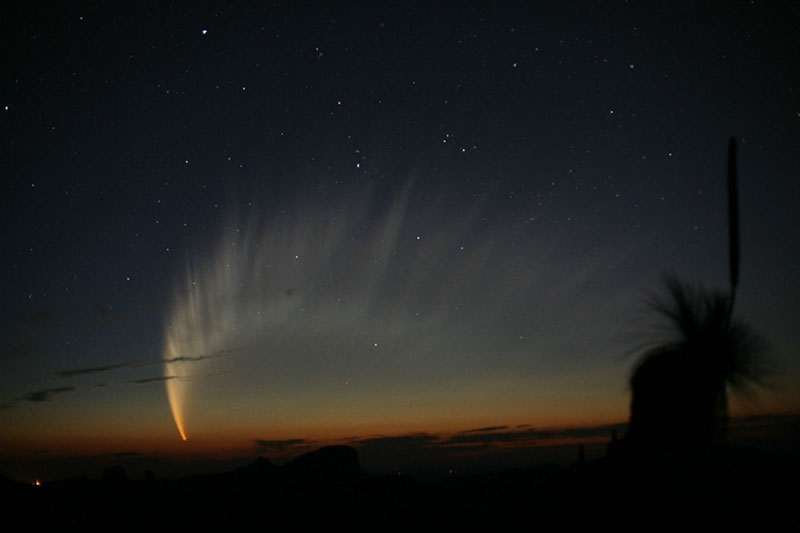
Sunday, December 16, 2007
Hot Jupiters

(Image Credit: NASA)
Picture a world where the year is 5 earth-days long, and the sun never rises or sets, but remains fixed directly overhead. The cloud tops on the sunlit side of the planet are thousands of degrees, and are made of vaporized minerals and metals. Iron smog and wisps of quartz are shunted from the scorching daylit side to the perpetually dark night side, which glows a dull red, pouring its excess heat into space. The upper hydrogen atmosphere is continually ripped from the planet and streams out into space like the tail of a comet.
Although it sounds like it belongs in the realm of science fiction, this description may actually be quite accurate for many of the planets that astronomers have found around other stars. The most successful method for detecting planets, called the "radial velocity" method, relies on detecting the small motions of stars as their planets orbit and tug them back and forth. Just as the siren on an ambulance is higher pitched when it is approaching than when it is receding, the light from a star looks slightly bluer when the star is moving toward us and slightly redder when it is moving away. Since the size of the shift depends upon the mass of the planet and how rapidly it orbits, many of the exoplanets discovered are larger than Jupiter, and orbit their star in a matter of days.
The first "hot jupiters" were a shock to the scientific community because it is thought that gas giants have to form very rapidly, before their star becomes hot enough to blow all of the primordial gas out of the system. To form so rapidly, most formation theories require the giant planets to form far enough out in the solar system for ices to be present. Too close to the sun and the only things that can clump together to form the seed for a giant planet are rocks. Farther out, beyond the so-called "snow line", ice can also clump together with the rocks, allowing the cores of giant planets to form rapidly and accumulate gas before it gets blown away.
Because ice appears to be required to form giant planets, how can they possibly form so close to their stars? The answer is: they don't! The latest research suggests that in the early days of a solar system, the planets move around quite a bit. Often, big planets toss small things like comets, asteroids, and protoplanets out of the solar system. As they fly off into interstellar space, these small pieces of debris take energy and angular momentum from the giant planet with them. The result is that giant planets tend to drift inward as they fling things outward. At the same time, if there is still gas in the system, the planet will also interact with that gas, creating waves. These waves also steal the planet's angular momentum and send it spiraling inward. In this way, a giant planet could conceivably form in the icy outer reaches of the solar system and then bully its way inward, scattering debris and making waves as it does so.
The story of hot Jupiters is a great example of science in action: giant planets were discovered a lot closer to their stars than they had any right to be, based on our understanding of planet formation. Far from weakening the theory however, the discovery of "hot jupiters" let scientists to figure out that planet migration is a very important process in the formation of a solar system. The theory emerged stronger than ever, able to explain a wider variety of potential solar systems.
So, next time you step outside, take a look at the rocks on the ground and think about a world so hot that those rocks vaporize and form clouds. And then, while you're marveling at that idea, remember that worlds like that really do exist!
"The Universe is not only queerer than we suppose, but queerer than we can suppose." - J.B.S. Haldane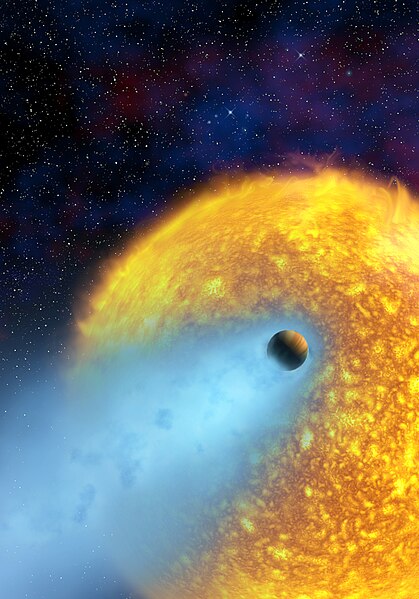
Image credit: European Space Agency, Alfred Vidal-Madjar (Institut d'Astrophysique de Paris, CNRS, France) and NASA.
Saturday, December 15, 2007
Science Debate!
There has been a recent movement among science blogs and activists to organize a science debate for the presidential candidates. This is, in my opinion, an excellent idea. It would not have to be like a science test, nobody expects candidates to be scientists, but we should expect them to be in touch with reality, and to understand how science affects policy. As our society becomes more reliant upon technology and faces challenges in medicine, energy, defense, and the environment, a scientifically literate president is crucial. I encourage everyone to check out the official Science Debate 2008 website, and read some of the excellent blog posts, and editorials on the topic.
Wednesday, December 12, 2007
Spirit Rover has Camoflage!?
In this recent "deck pan" of the Spirit rover, the solar panels are so covered in dust that they blend in almost perfectly with the surrounding dusty martian surface. 
All that dust means that the rover has less power to work with every day. With martian winter approaching in a few weeks, the Rover team has been working nonstop trying to drive Spirit to a location where the solar panels will be tilted toward the sun. The rover will camp there, trying to conserve energy until spring comes and there is enough power to drive once again.
Here's hoping for a gust of wind to clean off the panels and make life a little easier for Spirit...
Wednesday, December 5, 2007
A Candle in the Dark
Once finals are over, I will make a few honest-to-goodness posts, where I actually write a lot about something interesting. For now, enjoy this cartoon I found, and the Sagan quote that expresses the same idea but with a somewhat different tone...
"I worry that, especially as the Millennium edges nearer, pseudo-science and superstition will seem year by year more tempting, the siren song of unreason more sonorous and attractive. Where have we heard it before? Whenever our ethnic or national prejudices are aroused, in times of scarcity, during challenges to national self-esteem or nerve, when we agonize about our diminished cosmic place and purpose, or when fanaticism is bubbling up around us-then, habits of thought familiar from ages past reach for the controls.
The candle flame gutters. Its little pool of light trembles. Darkness gathers. The demons begin to stir."
- Carl Sagan, The Demon-Haunted World: Science As a Candle in the Dark
Subscribe to:
Posts (Atom)

